Wiscetiquette: A Women’s Guide to UW–Madison
By Arielle Raymos
The research in this publication was completed as a part of the University of Wisconsin–Madison’s Rebecca M. Blank Center for Campus History. The Center seeks to expand and enrich UW–Madison’s historical narrative by centering the voices, experiences, and struggles of marginalized groups. The Center grew out of the Public History Project which culminated in the Sifting & Reckoning physical and digital exhibition in the fall of 2022, curricular tools, an event and lecture series, and a final report. By sharing research, we hope to continue conversations about the history of UW–Madison and discuss how we can all work towards building a more equitable campus community. The nature of historical research is that it will always be incomplete. It is impossible for us to know everything that happened in the past. Therefore, the research in this post is imperfect, as all history is. Our researchers have completed the research below with all of the historical documents available to them at the time of publication.
“Emily Post, the girls felt, was all right in her place, but her place was quite evidently not a roadhouse bar or the Picnic Point road.” [1]
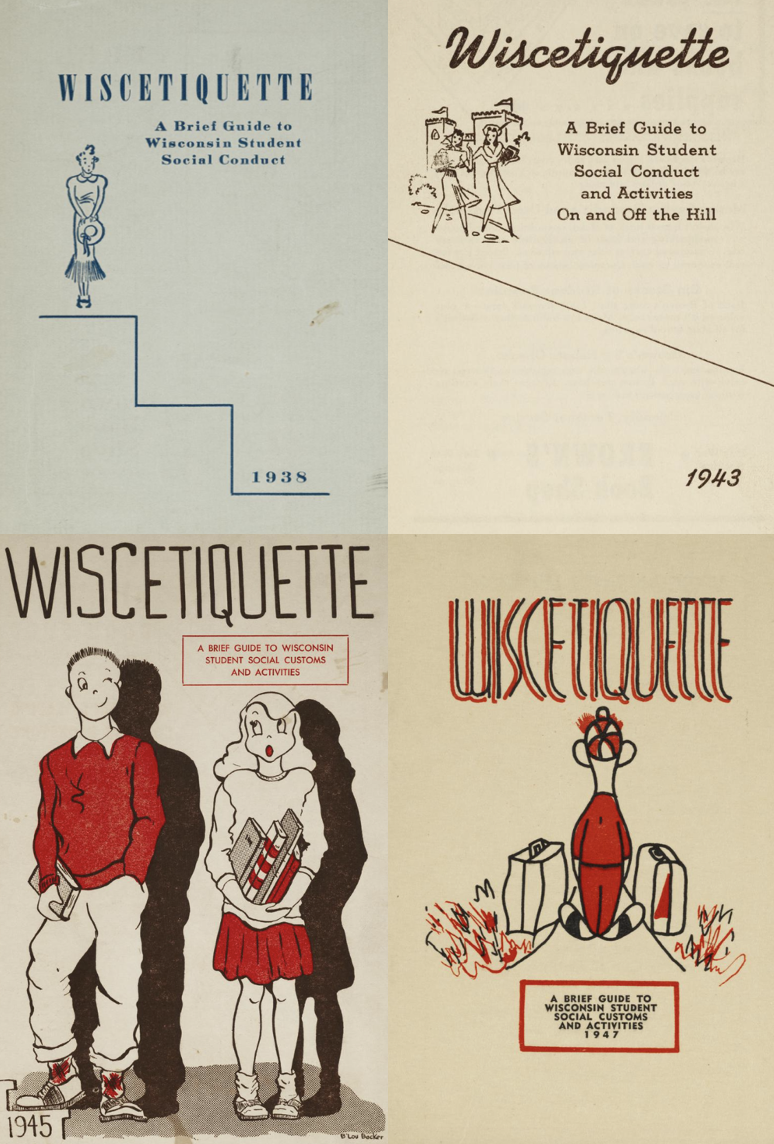
At a time when women on UW–Madison’s campus lived under strict rules about dress, behavior, and curfews, (a nighttime curfew for women students was not lifted until 1970) [2] a fascinating “etiquette” handbook was born. Conceived, written, edited, and published by women students at UW–Madison from approximately 1936–1960, Wiscetiquette contained a wealth of inside information on academics, social life, and traditions on campus. As the subtitles of each edition indicate, Wiscetiquette offered: “the hows and whys of student social life” (1936); “a pipe course in Wisconsin student social conduct” (1938); “a brief brief on etiquette” (1947).
More than just an etiquette book, Wiscetiquette serves as a primer for issues important to women on campus in the midcentury. The booklet is also part of a larger history of women students at UW–Madison. The women students who spearheaded this project sensed a gap in preparatory materials for incoming freshmen and sought to fill it. They were preceded by a tumultuous time for the general population of college students as well as the broader American public, and those larger events impacted the relations between men and women students at UW–Madison.
Octy Origins
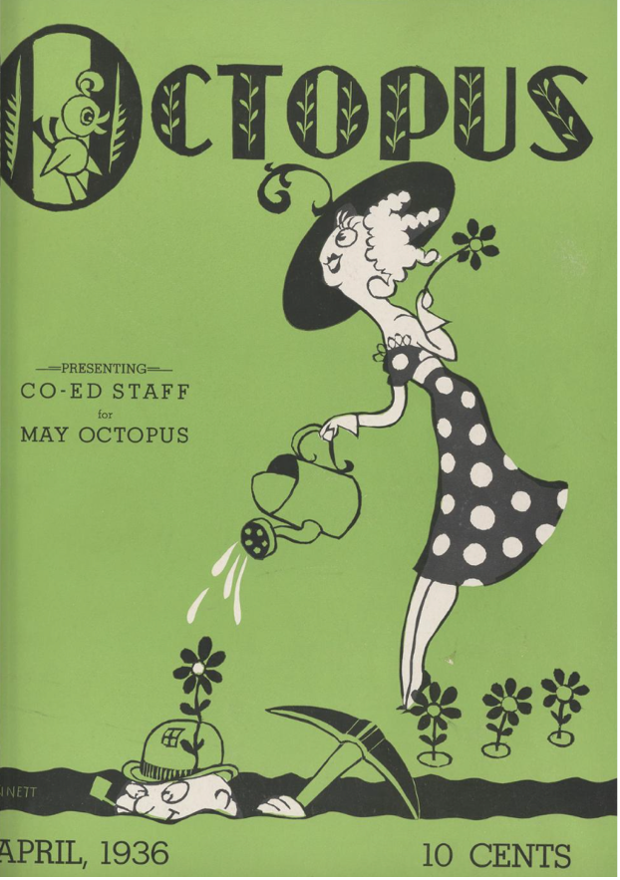
Wiscetiquette began in May 1936 as a feature in the campus humor magazine, the Octopus (affectionally known as the “Octy”). This special issue of the Octy, the “Co-Ed Number,” was created entirely by women students: the main editor, editorial board and staff, business board and staff listed were all women. [3] In the preceding issue, editor Charles L. Fleming previewed the “Co-Ed Number,” teasing “the long-awaited WSGA etiquette book, which will tell you when to send flowers (if you’re a guy) and when to tip the date off that you do not want to park on Observatory (if you’re guy or gal) and many other vital point”. [4] The editor also noted the “Co-Ed Number” would be “what we expect to be the best Octy in years”. [5] The “Co-Ed Number” highlighted women’s issues on campus, led by editor Catherine Ann Kelley, the Daily Cardinal’s society editor and University Theater lead actress; Carolyn McKay, a writer for the Octopus and candidate for Badger Beauty; and Helen Savage, who supervised “WSGA’s version of Emily Post brought up to date.” [6]
Fleming, the regular male editor introduced “Wiscetiquette” in the May 1936 issue with a wry column subtitled “in which the editor leans back and watches women work”[7]:
“I was talking with Helen Savage, the other day, about this Wiscetiquette, which is in the magazine someplace. She told me all about it — where the idea came from, who’s been working on it, what it’s all about.
It seems that the Women’s Affairs committee has long wanted to publish an etiquette booklet which would be informal enough to be read and still tell how things are done here at Wisconsin. Emily Post, the girls felt, was all right in her place, but her place was quite evidently not a roadhouse bar or the Picnic Point road.
Octy welcomed the idea with open arms, and Wiscetiquette is in this month’s magazine. The type and pictures will be lifted out and reprinted in booklet form, about the size of Reader’s Digest, for publication next fall. Helen Savage has been chairman, working under LaVergne Cooke’s WAC, which is under Carol Wagner’s WSGA, which gets complicated as hell all of a sudden. With Helen have labored Ruth Lynott, Marge Jacobson, Betty Steffen, and Paul Godfrey. Ruth Ricker did the drawings, and we all think they’re pretty darn cute, in spite of the impossible jackets she draws on the men. We like the whole idea, and we who inhabit this squirrel-house known as The Brown Study all intend to quote it on every possible occasion.
We have also learned to tip our hats to ladies and WSGA officers.”[8]
Both the informal tone and the portable, Reader’s Digest-sized format made Wiscetiquette unique amongst student guides and handbooks. Additionally, the all-female production team gave the content, as Fleming described it, a “feminine angle on the campus as we could never do it”. [9] The “we” Fleming refers to was undoubtedly male students — who occupied most of the highest editorial positions in campus publications as well as representing a larger portion of the UW student body than women. Whether conscious, subconscious, or tongue-in-cheek, Fleming acknowledged that the perspective of male students — the default for campus publications — was not representative of the entire student body; for that, UW needed the “feminine angle”. [10]

Initially, Wiscetiquette’s layout was notably bare bones. Line drawings were one color without shading or much detail. By the mid-1940s, red ink was introduced—a color combo that complements UW–Madison’s official colors nicely — and the drawings and cover art became more detailed, adding shading and dimension. Finally, in the mid 1950s–1960 as Wiscetiquette began to resemble university produced student handbooks with glossy photos of the chancellors, deans, and other administrative figures, as well as professional photos of the campus and notable landmarks. [11]
While Wiscetiquette offered advice to both women students and male students, the attention given to the perspective of women students is striking. The subject of “co-eds,” as women students were commonly known, had been a popular topic of discussion on campus since women were first allowed to enroll alongside male students in 1871, (although UW–Madison had gender-segregated colleges and courses since 1863.) [12] In order to understand the need women students had for a publication of their own — both to communicate social preferences and habits to other women, but also to communicate these things to men students — we must understand the general ratio of men to women on campus throughout UW–Madison’s history.
The number of women students on campus, while not documented officially at the time of Wiscetiquette’s publication, was a hot topic amongst students. It set the tone of the campus dating scene. The “ratio” was a popular term, referring to the ratio of men versus women on campus in any given year; the ratio was discussed most often during and post-World War I and II, as the dearth of male students led to a higher number of women students. The 1948 Badger yearbook, in a list of significant moments throughout the senior class of 1948’s time at UW–Madison, reminisces on the “surplus women, three to one…” [13] in 1944, the year the class of ’48 entered as freshmen (also the middle of America’s direct involvement in WWII). A line in an Octopus story one year after WWII described this when they quipped, “with the ratio being what it is on the campus, dating is always a rather hectic business.” [14] Three years later, the 1948 Badger yearbook laments that there was “1–3 of a girl now for every guy…” [15]
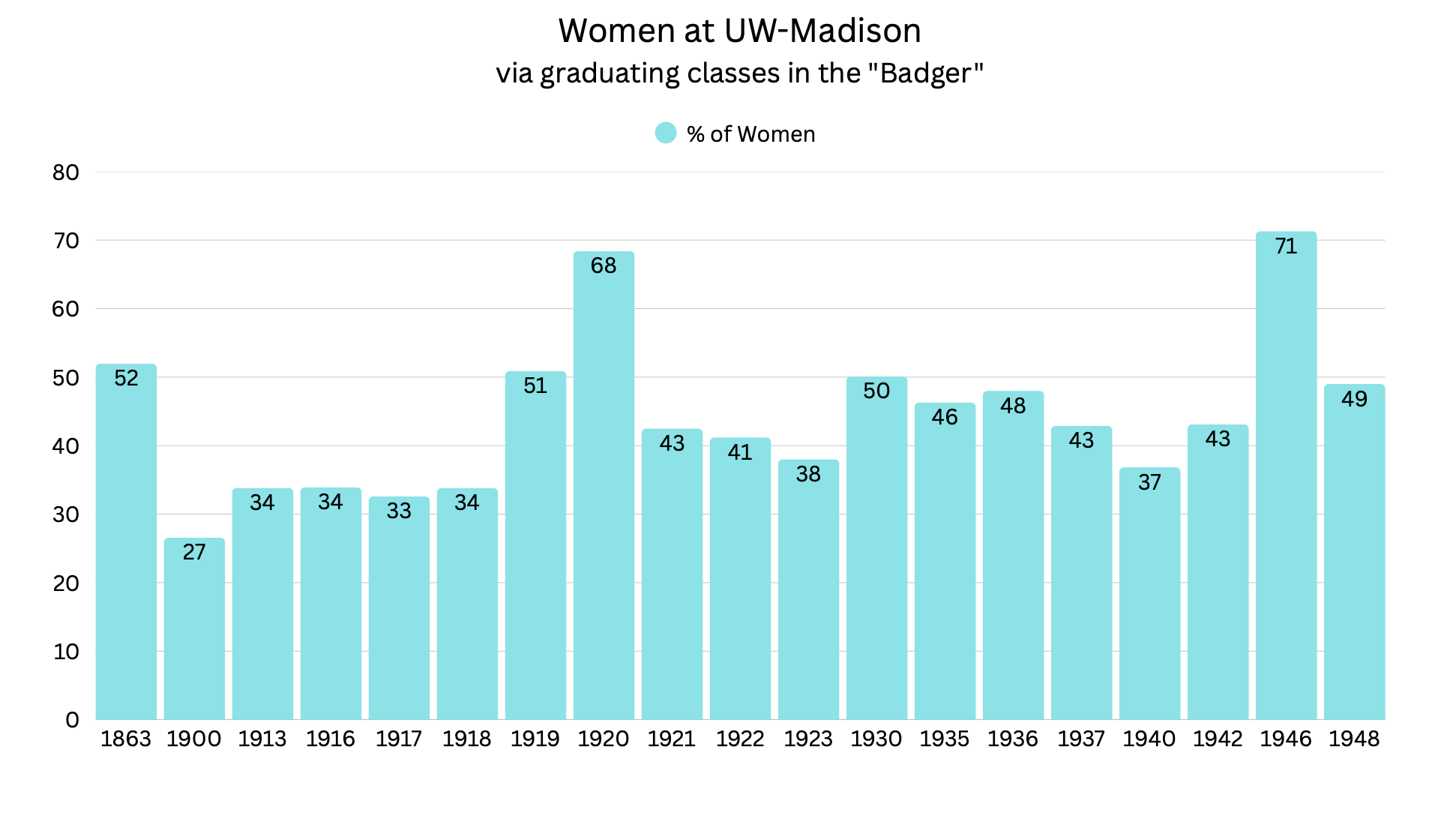
While there are no statistics on the number of women students at UW–Madison in these years, looking at the senior classes in the Badger yearbooks throughout a selection of years offers a rough estimate of the population of women on campus. Obviously, these statistics are not representative of the student population as a whole — class makeups could change significantly from freshmen to senior year, but as all the Badger yearbooks are readily available, with names and photos for every senior class, these statistics help us envision the percent of women at UW–Madison for a given year. Of note are 1923 and 1936 — the first due to the creation of a student organization decrying the number of women on campus, and the latter being the first year Wiscetiquette was published.
Additionally, the years chosen here take into account these major events that impacted student populations: Civil War (1861–1865); World War I (1914–1918); 19th Amendment (ratified August 18, 1920); World War II (1939–1945).
In 1923, discussions over women’s presence on campus reached a fever point. The Daily Cardinal documents an uproar over a newly proposed student organization: the “Society for the Welfare of Male Students.” The headline — published on Valentine’s Day — reads, “MEN’S WELFARE BODY STIRS IRE OF MANY CO-EDS: Indignance Expressed in Interviews.” [16]The Cardinal alternatively refers to the organization as the “Anti-Coed Marrying Society”; the “co-ed haters club”; and the “Protective Society against Co-ed Wives.” [17] One woman student opined: “Don’t you think that male students make as poor husbands as women students make wives…We will have to put up with the men; why shouldn’t they be expected to do the same?” [18]
The Cardinal’s initial article sparked such outrage that a piece published two days later meticulously outlined the difficulties that female students faced at UW–Madison, mainly when it came to renting rooms from private landladies around campus. They wrote that “the landladies concerned know that women students cannot be as independent as are men and take advantage of the fact.” [19] They conclude the piece by pointing out that “the co-eds have reason for some of their critical and ‘queer’ tendencies and characteristics,” and that they ultimately “deserve more sympathy than criticism.” [20] Addressing the Society for Men’s Welfare directly, they suggest that “the activity of the new formed co-ed haters club might well be directed toward removing some of the injustices which co-eds face rather than criticizing them unheard.” [21] Interestingly, one of the Cardinal’s headlines for this issue was, “CO-EDS DEBATE FORENSIC TITLE AND WIN DEBATE,” in which the question was “Which of the sex is superior?” [22]
This discussion continued into the next month with a letter to the editor written by a “Nebraska Co-ed” enumerating the many challenges women students faced on and off campus that men did not. In a “Student Forum” section titled “HE-MAN SKEPTICISM,” [23] the “Nebraska Co-ed” sarcastically lambasted the organization, beginning by exclaiming, “What an infinite relief such an action must be for the fair femininity at Wisconsin!” She concludes that “…methinks that when the balmy days of May cast their bright skies over our heads and the Wisconsin campus, the usual number of masculine fraternity pins will be peacefully resting over the palpitating hearts of the denounced and repulsed co-eds.” [24]
Three years prior to the formation of the Society for Men’s Welfare, the 19th Amendment to the US Constitution was ratified, giving white women the right to vote. [25] Thus, we might imagine that the men on campus were still harboring resentment towards the increased presence of women in politics as well as on campus, as there was a significant spike from 1919 to 1920 from 55% to 68% women students in the graduating class. Undoubtedly, WWI also played a large role in the increase in women on campus. While the numbers evened out by 1923, we can see the lasting impact of these events on the number of women students, as the percentages on average increase from previous years.
This environment — one with a consistent rise in the population of women on campus paired with male backlash to their increased presence — prefaced the creation of Wiscetiquette in 1936. The Society for Men’s Welfare preceded the first issue by a little over 10 years. While the female students reacting to the “Society” in the Cardinal highlighted the lack of discussion surrounding the challenges women faced on campus, a decade later, Wiscetiquette still saw that dearth and created a sort of answer to this incident by prioritizing women’s voices and perspectives.
The WSGA felt a pressing need for a casual, but informative, handbook that told students about campus social etiquette and provided dating and relationship advice. Students were not getting that information from university distributed student handbooks. And a possible side effect of disseminating this advice may have been to ease tensions between men and women students by facilitating more positive interactions between them.
With a better idea of the market that Wiscetiquette served — debuting in 1936, when women made up 48% of the senior class and ending in 1960, when women made up 39% of the senior class— we can explore what subjects women students were interested in reading about in preparation for the school year.
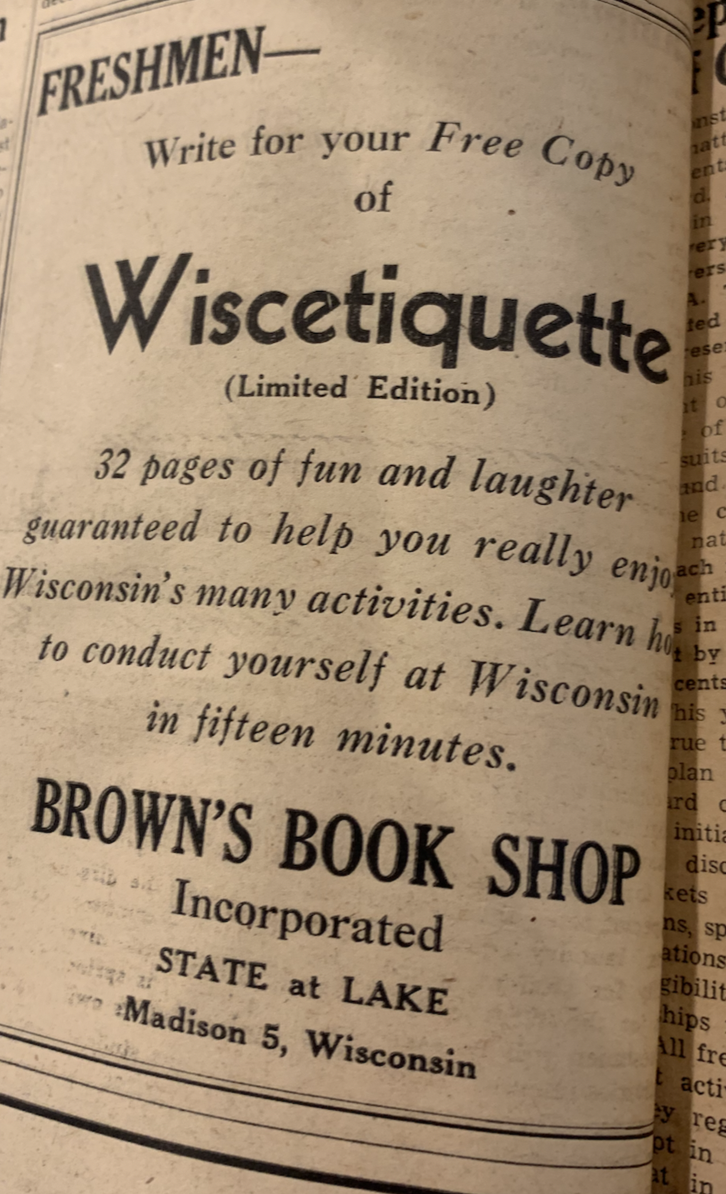
Wiscetiquette’s content reflects the WSGA’s desire to create a casual yet informative etiquette handbook for the campus community, with an eye towards the “co-ed” perspective and experience on campus. WSGA partnered with the Wisconsin Union’s Women’s Affairs Committee and Wiscetiquette was printed by Brown’s Book Shop on State Street at Lake Street: practically on-campus but not produced by the university directly. The various subtitles over the years indicate its priorities: to introduce freshmen to the social life of campus, in a short, easily digestible form.
What more could a new student want: a free book, available at a popular bookstore near campus, that tells you what’s going on around campus, and how to avoid embarrassing fashion and social faux pas, in just 15 minutes?! Nervous freshmen in colleges around the country would likely jump at the chance to purchase a booklet of this type, let alone pick it up for free while grabbing their books for the semester. The formats that Wiscetiquette used to communicate all these crucial pieces of advice in their publication varied. Much like today’s students are likely to be wary of reading excessively — especially outside of a class — the ladies in charge of Wiscetiquette knew that they had to convey quite a bit of information in a brief, interesting way, so that students would actually read their publication.
An important element within Wiscetiquette was the many charts and diagrams that covered a number of issues from student government to Union committees, to a dress calendar (for women and men!), and, of course, sports schedules. The academic calendar, however, was left to the university-issued student handbook.
Student government at UW–Madison is complex, and new students practically need a map to figure out the ins and outs — especially if they want to participate in any of the boards, councils, and/or elected positions. Luckily for those students politically inclined, Wiscetiquette included a branch chart outlining the Wisconsin Student Association and the Wisconsin Memorial Union, as well as detailed descriptions following the chart. The pride that Badgers take in the unique form of student government at UW–Madison is obvious in the detail put into explaining the different organizations and branches to incoming freshmen — it encouraged the newcomers to jump right in and get involved.

Additionally, as Wiscetiquette was the brainchild of Associated Women Students (AWS),[26] they also provided an overview of their organization — including the executive, legislative, and judicial branches, a chart of their structure, an event list, and a form for women students to sign up for the AWS “Big Sister” program.
Perhaps most important for aspiring socialite Badgers, along with event calendars and sports schedules, some issues of Wiscetiquette included dress charts for the school year — one for men and one for women. Additionally, each chart was accompanied by tips and suggestions for men and women regarding dress and style. These charts pair well with Wiscetiquette’s sections on dating and socializing at UW–Madison.
Overall, the charts encouraged students to get involved both in the social scene at UW–Madison as well as the student political scene. Easy to understand charts covered both committees and clothes. This dichotomy defined the interesting balance of Wiscetiquette: well-rounded academic advice paired with frank observations and information on social trends on campus.

Wiscetiquette was well-known around campus as a repository of campus traditions. In an issue of the Octy in 1949, Jack Stillman writes that “another tradition, according to a 1908 Wiscetiquette which was found when they cleaned out the W.S.G.A. office recently, allows any member of the sophomore class to spit in the eye of a freshman at high noon on Columbus day.”[27] While Stillman was obviously joking — it was a piece in the Octy — the mention of Wiscetiquette in an article discussing some of the “great number of hoary old traditions and institutions”[28] establishes Wiscetiquette both as a tradition and an institution on campus.[29]
Most issues of Wiscetiquette included a list of campus traditions, or as the 1952 edition lists, popular “events” on campus (which sometimes double as traditions). This section is a great way to track the consistency of traditions over the years. While some are clearly lesser-known activities that students attempted to codify as traditions, the lists share several of the same heavy hitters throughout Wiscetiquette’s run from 1936–1960. Two traditions specifically related to women’s behavior stuck around throughout the decades. One was related to the Abraham Lincoln statue at the top of Bascom Hill: as the legend goes, when a co-ed walked in front of the statue, Abe would stand if she was a “lady”. As bronze statues are not generally known to move on their own, women students were cautioned to avoid walking in front of him at all if they did not want to risk their reputations. While it was never said explicitly in Wiscetiquette, the clear implication was that a “lady” was a virgin. That one of the university’s longest running traditions revolved around women’s sexuality is no coincidence: women students were upheld to strict standards regarding their behavior, dress, and socialization on and off campus, with this “tradition” being one of the more informal (and arbitrary) ways of policing women’s sexuality on campus.
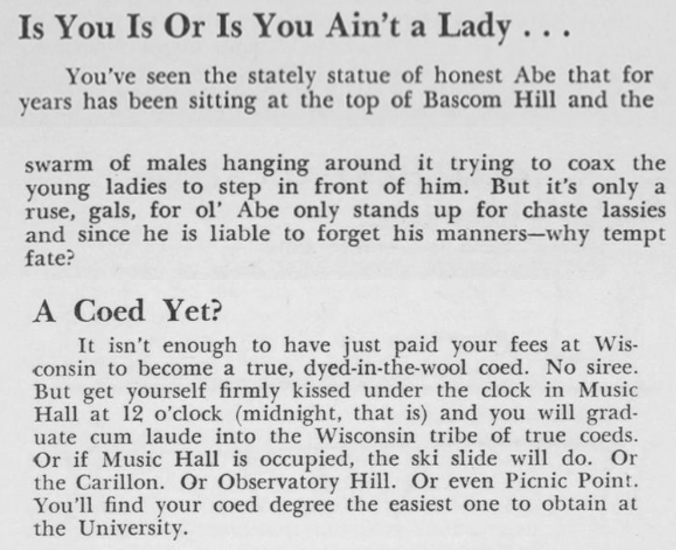
The second longstanding tradition purported to be the definitive marker of what maked a woman student a “real” co-ed at UW–Madison. The answer? Being kissed under the clock at Music Hall at midnight. …or Observatory Hill, or Picnic Point—basically, any landmark on campus.
Despite not being on campus until 1863, two of the longest-lasting traditions involve women students. Those traditions revolve around definitions of femininity: was she a “lady?” Was she a “real co-ed?” Exploring the deeper meaning of these two traditions fits within the larger history of women’s presence at UW–Madison: existing as college students was not enough; being tolerated on campus was contingent upon proving they conformed to certain idealized conceptions of “real” ladies or “real” co-eds.
As Wiscetiquette became increasingly filled out with university sponsored photographs and “welcomes” from chancellors, deans, and other administrators in the late 1950s–1960, the traditions also got a bit more “university sponsored” overall. The tradition lists, rather than including more esoteric traditions, instead featured more “official” university sponsored items/activities: “numen lumen,” the university seal, Bucky Badger, “On Wisconsin;” and highlighted student organizations offering entertainment on campus, such as Wiskits and the Haresfoot Club. However, even as the university’s presence increased, Wiscetiquette still included more antiquated traditions like “Honest Abe” and “A Coed Yet?”
It is difficult to gauge how the campus received Wiscetiquette, although its run from 1936–1960 suggests the “brief brief” had a steady audience. However, a 1949 letter to the editor of The Daily Cardinal indicates not everyone on campus was charmed by the little booklet:
‘WISCETIQUETTE DISHONEST’ [30]
“Maybe I’m a hardened, cynical senior. I can’t help it. But a little booklet entitled “Wiscetiquette” has me feeling ill.
Among the gems of advise proferred [sic] to the innocent frosh are such as: “At Wisconsin, we shake our heads at people who cut classes.”
(Really – My advice to freshmen is to find out how many cuts are allowed, take ‘em, and if the course is dull, take twice as many. In many introductory courses the profs merely parrot their texts anyway, and the lectures are meaningless.)
“Cribbing doesn’t go on our campus. It’s the easiest way (out of school, that is.) It’s not worth taking the chance.”
What incredible naivete and idealism! Apparently the authors are not familiar with the mores of a great many students. Not only that, but it is only fair to inform the freshman about the complete exam files kept by fraternities and dorms.
The booklet is substantially a good idea. But in the attempt to be cute, it falls on its face. And as far as honesty, it could use a little more.
(name on file)
Our “old sourpuss” [31] here takes offense because of the delicate line that Wiscetiquette toed in giving its advice in an informal tone. The creators wanted the advice to be realistic and helpful to students, but, of course, a booklet published by the WSGA (later AWS) and the Wisconsin Union Women’s Affairs Committee could not endorse things like cheating or playing hooky.
A key reason that Wiscetiquette could give more informal advice about things like dating and fashion was due to its off-campus publication by Brown’s Book Shop. It was not overseen or produced by the university, but rather women students who sought to be on the editorial and writing team. The WSGA ran ads for those interested in joining in the Daily Cardinal.
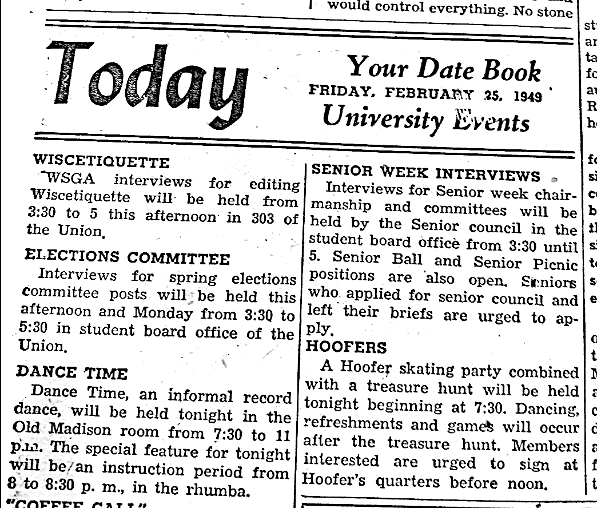
It is easy to understand why the AWS and the Wisconsin Union Women’s Affairs Committee would not want to speak freely about the rate at which students played hooky and cheated on exams, but it is interesting that the “old sourpuss” does not pick on any of the social, dating, clothing, or other slightly unconventional advice given in Wiscetiquette — just the unrealistic presentation of academics. This response communicates that Wiscetiquette’s social advice was accurate to the experiences of actual students.
In terms of a more general read on women students at UW–Madison well into Wiscetiquette’s run, reporting in the Cardinal demonstrates that they were making their presence and opinions known around campus. One 1949 headline declares that “Co-eds know best: Fair sex excels in grade average,” [32] while another discusses the “Male female ratio.” [33] Another topic of debate during this time was so-called “co-ed hours”: curfews for women students. Rosemary Witko penned an opinion column to “speak out on co-ed hours: ‘adults until proven children!” [34] Witko’s primary demand was that “the “no-hours” policy now in effect for men should be extended to women students as well.”:
“It is invalid because the university is saying in effect that men are by definition more mature, responsible, and capable than women students; that the latter are by nature weak and dependent and because they are incapable of assuming responsibility for their own actions, the university must do so.
[…] A “no-hours” policy for women would give them equal opportunity with men to develop mature judgement, a sense of responsibility, and independent thinking — all of which our society badly needs today. As it stands now, the unnecessary and hampering restrictions which hours place on the woman student prevents her from realizing this fuller growth and development. Instead, the university takes up where most parents leave off, and the mollycoddling and babying of the students continue into adulthood.” [35]
A few weeks later, Dick John addressed the “Fascist! but nice—those co-ed hours.” [36] He pointed out — correctly — that “the people who make the rules are campus women”: the AWS did vote on and determine women’s hours. More tongue-in-cheek, John explained that “the only campus women who have time to go to meetings at which the rules are adopted are those who do not have dates,” and that it “becomes apparent that those who make the rules are actually jealous of the other co-ed’s success…and naturally wish to curtail this success as much as they can without appearing to do so.” [37] John concluded, “But if this be fascism, let us make the most of it. We know that we speak for many harried campus males when we say— “we get so darn tired.” [38]
While John was obviously writing in jest, he did point out some legitimate aspects of women’s hours, which, in 1949, were 10:30 p.m. on weeknights and 12:30 a.m. on weekends. Rita Torgerson responded to John in “ASSUMPTIONS RESENTED! Co-ed debate – from a woman.” [39] Torgerson pointed out that, in class, she is “apparently thought mature and intelligent enough to examine and come to a conclusion on all manner of problems” while “out of class, in [her] social life, [she] must be incarcerated in [her] dormitory,” and concludes that “obviously either [her] intelligence or morals are found lacking.” [40]
This exchange over women’s hours in 1949 resembles that of the “Society for Men’s Welfare” debate in 1923. In both, men expressed an opinion on women students’ lives on campus. However, in each case, women students responded, voicing their own experiences on campus to refute the male point of view. While Dick John’s “opine” was satirical, Torgerson’s response acknowledged this while pointing out that this issue that John joked about represents a “fallacy of a double standard” which “exist[s] under a system of supposed equality for men and women.” [41] In other words, the assumption that women’s hours operate under — that women were not capable of responsibly managing their own lives — was not a joke to Rita Torgerson.
Both these exchanges and Wiscetiquette speak to a larger tradition of women students speaking out at UW–Madison. From 1923 to 1949, to plenty of contemporary examples, UW–Madison’s women students make their voices heard. In the mid to late 1950s into 1960, Wiscetiquette shifted from a grassroots publication from women students to something more along the lines of a university-sponsored student handbook. UW–Madison’s women students still made their voices heard on campus, but not in the form of a social etiquette book.
Wiscetiquette Wanes
Wiscetiquette’s delicate dance with its content also foreshadowed the university’s increased presence in the final issues of Wiscetiquette. Whether due to the university’s involvement or not, the AWS ceased publication of Wiscetiquette in favor of a more formal “student handbook,” titled On Wisconsin (not related to the current magazine of the same name).
While the AWS may have simply decided to move in another direction with their goals —as the 1959–1960 issues do resemble student handbooks more than the original, quirky design and its informal approach — it was no coincidence that, as Wiscetiquette began to feature glossy photos of the university campus and personal welcomes from deans and chancellors, it signaled the beginning of the end for the publication that started as a quirky, line-drawn booklet that gave genuine, experience-based advice to incoming students.
Wiscetiquette is a charming booklet at first glance, and its charm only increases as one reads the content itself, which offers a unique glance into what life was like for UW–Madison students in the midcentury. What really makes Wiscetiquette stand out, however, is the all-women editorial staff, writers, and illustrators: their perspective is obvious in the curation of the content, and their lived experience as campus “co-eds” gives weight to the almost shockingly liberal advice given at times, such as drinking, dating, etc.
The creation of the “Society for Men’s Welfare” in 1923 led to women students publicizing the difficulties they had navigating both campus and the surrounding community in the Daily Cardinal. A decade later, the creators of Wiscetiquette still saw a gap in the information provided to women students. When viewed in context with the history of women on campus, a women-led publication that spoke in such frank tones about their day-to-day lives is an extremely valuable starting point to explore women’s presence at UW–Madison. A look at the population of women students on campus throughout the early- to mid-20th century highlights the massive fluctuation in the population of women on campus during and after the World Wars, as well as the impact of the 19th Amendment. These events led to large spikes in the population of women but evened out into general increases in the following years. Through these statistics, we can see what preceded the male backlash to women on campus: women gaining a larger presence. And this larger presence created the gap that Wiscetiquette sought to fill: many of the same issues that women students in 1923 pointed out. It appears women students had to work against those issues themselves. One strategy was through Wiscetiquette.
[1] “Editor’s Brown Chair.” The Wisconsin Octopus, vol. 15, no. 9, May 1936, p. 36.
[2] Even then, freshmen women’s parents could still request a curfew for their child, according to an article from Sept. 12, 1970 (University of Wisconsin–Madison Archives, Subject File Collection, Box 124, Folder 6).
[3] Except for Paul Godfrey, listed under the Wiscetiquette staff and mentioned in the May 1936 Octopus – I would guess he might have been the illustrator, but Fleming mentions that Ruth Ricker did all the illustrations.
[4] The Wisconsin Octopus, vol. 15, no. 8, April 1936, p. 24.
[5] Ibid.
[6] Ibid, p. 9.
[7] Wisconsin Octopus, May 1936, p. 26.
[8] Ibid.
[9] Wisconsin Octopus, April 1936, p. 24.
[10] Ibid.
[11] Wiscetiquette’s distinct line drawings are representative of the technologies available for periodical publishing in its time. Much like lesbian and gay periodicals that began in the 1940s and lasted into the 1960s and beyond, the trajectory of Wiscetiquette’s visual design illustrates the printing technology available during its run. The cover art and illustrations in the lesbian periodicals Vice Versa (1947–1948) and the Ladder (1st issue in 1956) as well as the gay periodical ONE magazine (1st issue in 1955) follow the same trajectory in terms of visuals: simple line drawings become printed photographs. Most lesbian/gay periodicals in the 1950s–1970s were first typed on a typewriter, with the typewritten copy being used to make copies with a mimeograph. Due to the grassroots nature of these publications and the volunteer labor that produced them, the mimeograph was the preferred printing method, as it was cheap, easy to use, and widely available. The mimeograph stayed in use long after printing technology advanced, still used by student groups and small organizations well into the 1990s. As Wiscetiquette was distributed for free and printed by the WSGA/AWS with women students serving as the editors, writers, and artists, one can imagine an ascetic working environment much like that of early lesbian/gay periodicals, in terms of technology.
[12] Hathaway, Wisconsin Alumni Association, “Pioneers in Education,” March 15, 2011.
[13] 1948 Badger, p. 108.
[14] Omholt, Art. “Gregory,” The Wisconsin Octopus, vol. 25, no. 4, Dec. 1949, p. 31.
[15] 1948 Badger, p. 148.
[16] Daily Cardinal, February 14, 1923, front page.
[17] Daily Cardinal, February 14, 1923, front page; February 16, 1923, p. 4.
[18] Daily Cardinal, February 14, 1923, front page.
[19] Daily Cardinal, February 16, 1923, p. 4.
[20] Ibid.
[21] Ibid.
[22] Ibid, front page.
[23] Daily Cardinal, March 3, 1923, p. 4.
[24] Ibid.
[25] Black women were not fully guaranteed the right to vote in America until the Voting Rights Act of 1965.
[26] AWS was known as the Women’s Self-Government Association (WSGA) until 1953.
[27] Stillman, Jack, “Advisors, Inc.” The Wisconsin Octopus, vol. 28, no. 1, Sept. 1949, “Advisors, Inc.,” p. 2.
[28] Ibid.
[29] Ibid. Stillman also snarks that “The Daily Cardinal is neither an institution nor a tradition.”
[30] Daily Cardinal, Sept. 21, 1949, “Comment,” p. 4.
[31] At some point in 1948–1949, amidst a Red Scare invoked “naming scandal” involving then-Dean Paul Trump requiring (progressive) student organizations to submit complete membership lists to the Student Personnel Office—and the House Un-American Activities Committee (HUAC) visiting campus—a reader wrote to The Daily Cardinal lamenting the habit readers had of signing off with an amusing moniker related to their letters—such as our “old sourpuss” in this letter; “Beer Lover” in another—and admonished the paper for not requiring full names when publishing reader letters. TheCardinal, with good humor, remedied this “issue” by adding “(name on file)” after every letter signed with a silly moniker for a long period.
[32] Daily Cardinal, April 28, 1949, front page.
[33] Daily Cardinal, September 20, 1949, front page.
[34] Daily Cardinal, April 8, 1949, p. 4.
[35] Ibid.
[36] Daily Cardinal, April 27, 1949, p.4.
[37] Ibid.
[38] Ibid.
[39] Daily Cardinal, April 30, 1949, p. 5.
[40] Ibid.
[41] Ibid.
Bibliography
Alumni Park Exhibits, alumnipark.com/exhibits/featured/wiscetiquette.
Daily Cardinal, The. New Daily Cardinal Corporation, 1948–1950, UW–Madison Archives.
Daily Cardinal, The. New Daily Cardinal Corporation, 1894–, UW–Madison Digital Collections.
Hathaway, Wendy Krause. “Pioneers in Education.” Wisconsin Alumni Association, March 15, 2011, uwalumni.com/news/pioneers-in-education/.
Rademacher, Chelsea. “Dress to Impress,” Wisconsin Alumni Association, March 1, 2016, uwalumni.com/news/dress-to-impress.
Seidlitz, Esther. “Good and Bad Advice from UW’s Past,” On Wisconsin, onwisconsin.uwalumni.com/good-and-bad-advice-from-uws-past.
Wiscetiquette, 1936–1959, UWDC, digital.library.wisc.edu/1711.dl/7PG3MYRSW33RI8Z.
Wiscetiquette, 1948, Arielle Raymos, personal collection.
Wisconsin Badger (UW Yearbooks), 1885–2012, University of Wisconsin, UW–Madison Digital Collections, digital.library.wisc.edu/1711.dl/NBVOYDIJSV65G8L.
Wisconsin Octopus, vol. 15, no. 8, April 1936, UW–Madison Digital Collections, digital.library.wisc.edu/1711.dl/7IHSJX3NHK3WF9E.
Wisconsin Octopus, “The Co-ed Number,” vol. 15, no. 9, May 1936, UW–Madison Digital Collections, digital.library.wisc.edu/1711.dl/VDJ7OXEFVYGMF8L.