Protesting for a Place: How UW Students of Color Organized for Inclusion
By Allie Morris
The research in this publication was completed as a part of the University of Wisconsin–Madison’s Rebecca M. Blank Center for Campus History. The Center seeks to expand and enrich UW–Madison’s historical narrative by centering the voices, experiences, and struggles of marginalized groups. The Center grew out of the Public History Project which culminated in the Sifting & Reckoning physical and digital exhibition in the fall of 2022, curricular tools, an event and lecture series, and a final report. By sharing research, we hope to continue conversations about the history of UW–Madison and discuss how we can all work towards building a more equitable campus community. The nature of historical research is that it will always be incomplete. It is impossible for us to know everything that happened in the past. Therefore, the research in this post is imperfect, as all history is. Our researchers have completed the research below with all of the historical documents available to them at the time of publication.
Since colleges have existed in the United States, there have been student protests. The first recorded protest took place in 1766 at Harvard University with the “Great Butter Rebellion,” and they have continued to evolve. Some of the most recognizable college protests occurred in the 1960s, when college students across the United States protested for racial equality and against the Vietnam War. The University of Wisconsin–Madison has its own long history of protests, but it was during this era that UW–Madison crystallized its reputation as a “protest school.” Resident Madison historian, Stuart Levitan, puts it this way: “If you’re writing about Madison, you’re writing about the university. If you’re writing about the university in the ’60s, you’re writing about the protest movement.” 1
Historical and popular accounts often link protest movements to college students, like the ones on UW–Madison’s campus. But if student activism is foundational and persistent in American history, what makes colleges and universities unique sites of political mobilization? How does a freshman arriving at campus for the first time become a student activist standing at the picket line? In other words, what makes college students prone to protest?
Some experts argue that age drives college students to protest. American psychologist Jeffrey Jensen Arnett argues that 18- to 25 year-olds are uniquely positioned to fight against “the man.” Traditional college students, those who attend college relatively soon after graduating high school, are in the life stage called “emerging adulthood.” These emerging adults are often living on their own for the first time, encountering diverse ideas, people, and futures. This, mixed with idealism and hopefulness about the future, offer one explanation for why college students protest. But if it’s age alone, then why are not all 18- to 25 year-olds protesting? The answer is undoubtedly complex, but through oral histories of UW–Madison’s student activists during the ’60s and ‘70s, a clearer story emerges. That story has everything to do with the campus environment, or more specifically, its injustices. 2
The moment that Sara Jackson-Brunson, Harvey Clay, and the members of the La Raza Unida, a student organization created by Chicane/x and Latine/x students, arrived at UW–Madison, they faced social, cultural, and intellectual discrimination. 3 Yet, they harnessed their experiences into action. These students of color found or created social groups and organizations that acted as social, cultural, and academic havens amidst a discriminatory campus. These spaces were also incubators for political activism, where students expressed their frustrations and devised solutions. For some, like Sara Jackson-Brunson, working through the “proper channels,” — demanding change through established processes and working with university leadership — proved to be a successful solution in altering the campus environment for the better. But in many cases those channels failed. Students continued to face apathy, pushback, and attacks from their own campus. This is when students chose picket lines, marches, and boycotts. What began with discrimination ended with demands to hold the institution accountable to its promises.
The university has the potential to support the intellectual, social, and cultural growth of its students and facilitate students’ civic engagement. UW–Madison’s very own “Wisconsin Idea” promotes such things: “Education should influence people’s lives beyond the boundaries of the classroom.” But what happens when the university fails to deliver? It is students — like Jackson-Brunson, Clay, and the members of La Raza Unida — who demand that the university overcome its failures because they are the ones who believe in its potential. 4
Sara Jackson-Brunson, 1965-1969
Sara Jackson-Brunson arrived at UW–Madison in 1965 and described her initial semesters as “a very isolating experience.” She found that “there weren’t that many other Black students on campus.” In fact, Jackson-Brunson was the first Black person her freshman roommate had ever met. Jackson-Brunson’s roommate, a white woman from an all-white suburb of Milwaukee, took Jackson-Brunson everywhere, including her hometown “to show [Jackson-Brunson] off as the Black person she knew.” Being the only Black woman at a predominantly white campus was traumatic for Jackson-Brunson. She recalled “being in a crowded room and I was the only Black person at this event… and I literally had a panic attack.” The isolation she experienced was detrimental to her health and well-being, but when she turned to the university for help, she only found indifference. “There was just no support,” Jackson-Brunson remembered, “and that’s something that I really felt at that point in time because I was really struggling trying to figure out what I wanted to major in.” Jackson-Brunson came to UW–Madison to be a math major, but ultimately switched to psychology because she did not receive the resources she needed to succeed. Unfortunately, this was not unique to Jackson-Brunson’s experience. She knew several Black students whom the university recruited but failed to provide with resources. Many dropped out before they could finish earning their degrees. For Jackson-Brunson, however, her parents instilled the importance of education and she knew that dropping out was not an option. So, she sought out other forms of support, which she had learned about from her female family members. 5
Jackson-Brunson’s mother, great-aunt, and cousin all belonged to local chapters of Alpha Kappa Alpha Sorority, Inc. (AKA), the oldest Greek-letter organization established by African American women. The sorority’s mission is to empower women economically, culturally, intellectually, and politically. Jackson-Brunson knew that in order to survive UW–Madison and grow into who she wanted to be, it required spaces like the AKA sorority. AKA chapters had spread across the U.S. by 1965, but there was no AKA chapter at UW–Madison. Determined to find a haven away from the overwhelmingly white campus, Jackson-Brunson traveled to the nearest AKA chapter in Milwaukee. The two-hour bus ride to Milwaukee most weekends was difficult for her, but the space was important enough for her to travel back and forth for years. 6
Jackson-Brunson wanted to bring some of that community back to Madison. There was still no official AKA chapter at UW–Madison, but Jackson-Brunson hosted parties at the student union where Black students danced and sang their own renditions of popular songs. Jackson-Brunson remembers that “only Black students came to these parties,” and they provided her support when the university failed to do so. Emboldened by her experience with Milwaukee’s AKA chapter, but frustrated that there was still no AKA chapter at her campus, Jackson-Brunson demanded that UW–Madison alter their campus. Other Black Greek-letter organizations (BGLOs) had been fighting for organized spaces on campus since the 1940s, but those efforts were unsuccessful. 7 During the early to mid 1960s, Black students strengthened their fight to establish BGLOs at UW–Madison. These organizations, as Jackson-Brunson had found at the AKA chapter in Milwaukee, were “expressions of the need for solidarity and mutual support in the face of a frequently hostile and demeaning campus environment.” Yet, carving out these Black spaces as respite from the hostile and demeaning environment led to more hostility, particularly from the white Greek-letter organizations (WGLOs). Despite the UW Human Rights Committee issuing the “1960 Clause,” which banned racial discrimination in Greek-letter organizations, many WGLOs continued to discriminate. Black students reported ongoing discrimination within Greek-letter organizations, but the university never followed up on the complaints. 8
The university similarly did not take immediate action when Black students petitioned for BGLOs as a solution to the persistent discrimination. Instead, they encountered the long and arduous process of “sticky bureaucratic policies,” or the “proper channels.” That is, until 1968, when there was a shift not just for the BGLO movement at UW–Madison, but the larger Civil Rights Movement. When Dr. Martin Luther King, Jr. was assassinated, civil rights protests on college campuses erupted in mourning across the country. Jackson-Brunson recalled her devastation after she had learned of Dr. King’s assassination. Fueled by the loss of Dr. King, college students across the nation demanded universities take action in confronting racism. At UW–Madison, leadership finally responded by supporting the establishment of multiple Black Greek-letter organizations, including the Epsilon Delta chapter of AKA. The establishment of AKA and other BGLO’s was not the byproduct of benevolence from the university. Rather, it was the mounting pressure from students that became too overwhelming to ignore. 9
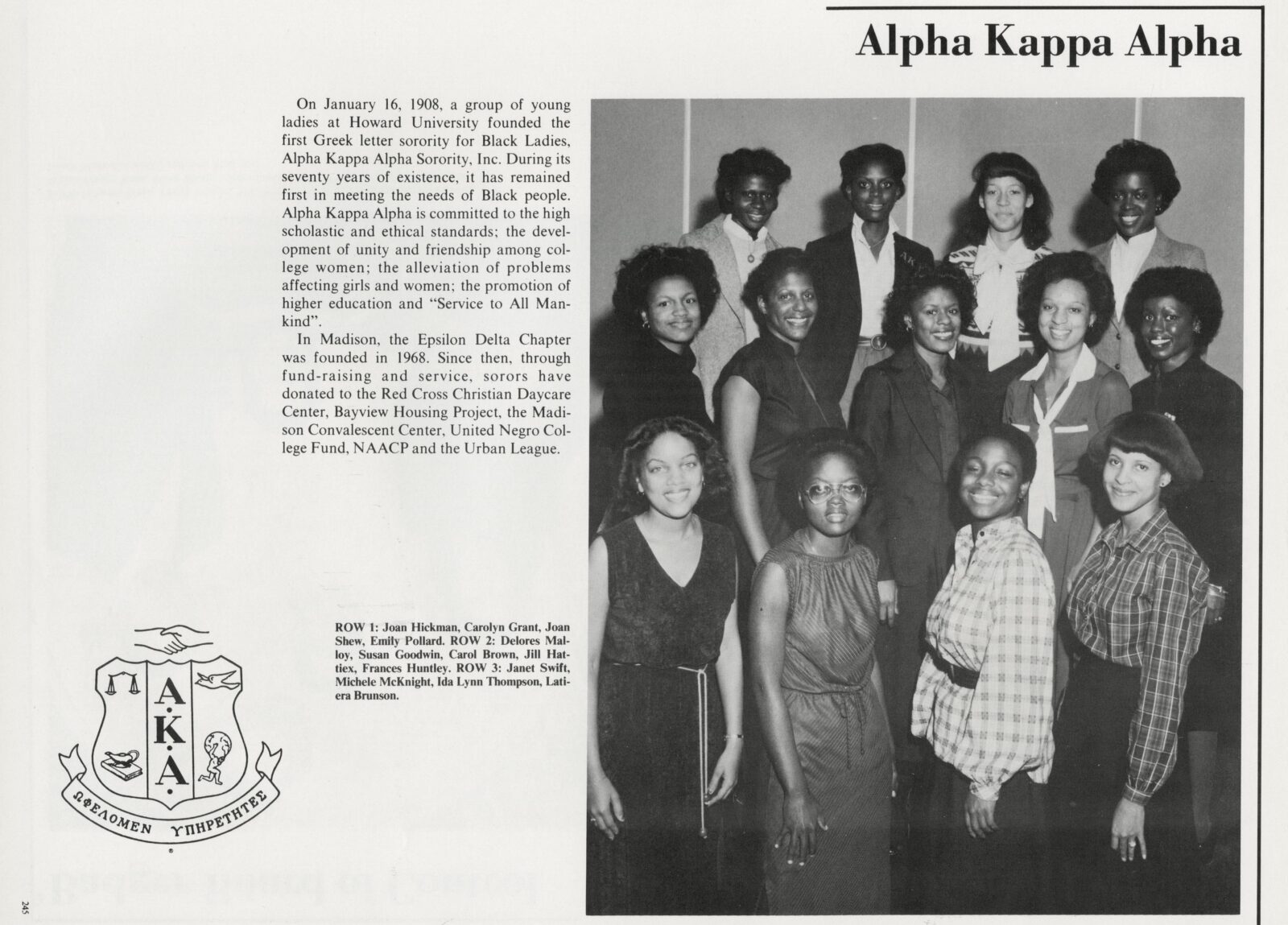
In May of 1968, Jackson-Brunson and her cohort of Black women activists established their own AKA chapter on UW–Madison’s campus, where Jackson-Brunson became chapter president. Jackson-Brunson leased a sorority house with no more than six sorority members residing in it. Despite such a small space, the environment “was very supportive.” “It was like a family,” said Jackson-Brunson, “even the pledge line that came after the group I was in, we were like big sisters to them.” The Epsilon Delta chapter changed students’ experiences for the better. In addition to community, it also provided the academic support the university failed to deliver. AKA members frequently helped each other with classwork, offering resources for students’ academic success. In fact, Jackson-Brunson credits AKA as the support system that emboldened her to complete her degree in psychology. After graduating from UW–Madison, she earned her master’s degree in counseling and worked in the field of equal opportunity and diversity. It was her experience in the Epsilon Delta chapter that inspired her continued activism for racial justice long after she graduated from UW–Madison. 10Reflecting on the impact of her sorority, Jackson-Brunson said, “It was probably the best thing that could have happened because it really gave you a sense of community and a sense of belonging.” 11
The Epsilon Delta chapter was not established by picketing or demonstrations, and Jackson-Brunson did not boycott or go on strike. Yet, the fight to establish a Black sorority was a political act. Jackson-Brunson’s activism did not occur in a vacuum, and she felt what she was fighting for — an autonomous Black space at a predominantly white institution (PWI) — was just one motor of change in the larger Civil Rights Movement. Carving out a physical space for her and other Black women was not only essential to surviving the hostile, white campus but foundational for building community, resistance, and perseverance at UW–Madison and beyond. Black Greek-letter organizations, including Epsilon Delta chapter, “became the first organized Black space[s] on campus.” But it certainly did not become the last space nor the last instance of students protesting a hostile white campus environment. 12
Harvey Clay, 1968-1970
Harvey Clay moved from segregated Texas to UW–Madison on a scholarship to play football, but this was not an easy transition. Clay had not expected the culture shock of living in the Midwest, and he grew increasingly frustrated with the lack of Black spaces and culture. He was left with no obvious path to find community like he was used to in his segregated hometown. “I mean it’s a simple thing,” Clay said, “of getting a bottle of hot sauce, having a pot of greens, or getting some pinto beans or some black-eyed peas, or some greens, cornbread.” But it was not just his cultural and social experiences that left Clay isolated and frustrated; it was also his experiences in the classroom. 13
While some scholars credit college’s educating mission as the fuel for college protests, it was the limitation, not the possibility, of formal education that politicized Clay. Clay found the transition to academic courses extremely challenging, but when he reached out to his football coaches for guidance, they remained indifferent. “They wanted me to be an athlete, end of story,” Clay said. Anytime Clay discussed his academic life to his coaches, they said, “work harder.” It was the bootstrap theory, except Clay “didn’t have any boots.” Clay’s educational experiences, or rather the limitations of his educational experiences, formed the basis of his political motivations. But Clay quickly found that he was not the only one who grew frustrated with the social, cultural, and educational environment at UW, and he was not the only student whose frustrations fueled their motivation to protest. 14
Up at UW–Oshkosh, Black students had expressed similar grievances with their campus environment. Despite years of recommending solutions through the proper channels, university leaders refused to take Black students’ frustrations and solutions seriously. So, the Oshkosh students escalated their tactics. On November 20, 1968, nearly 100 Black students occupied the president’s office, demanding that the university respond. The university’s response? They arrested and expelled all 94 students. Ironically, what became known as “Black Thursday,” when UW–Oshkosh acted so aggressively, sparked the most successful student protest in UW–Madison’s history. 15
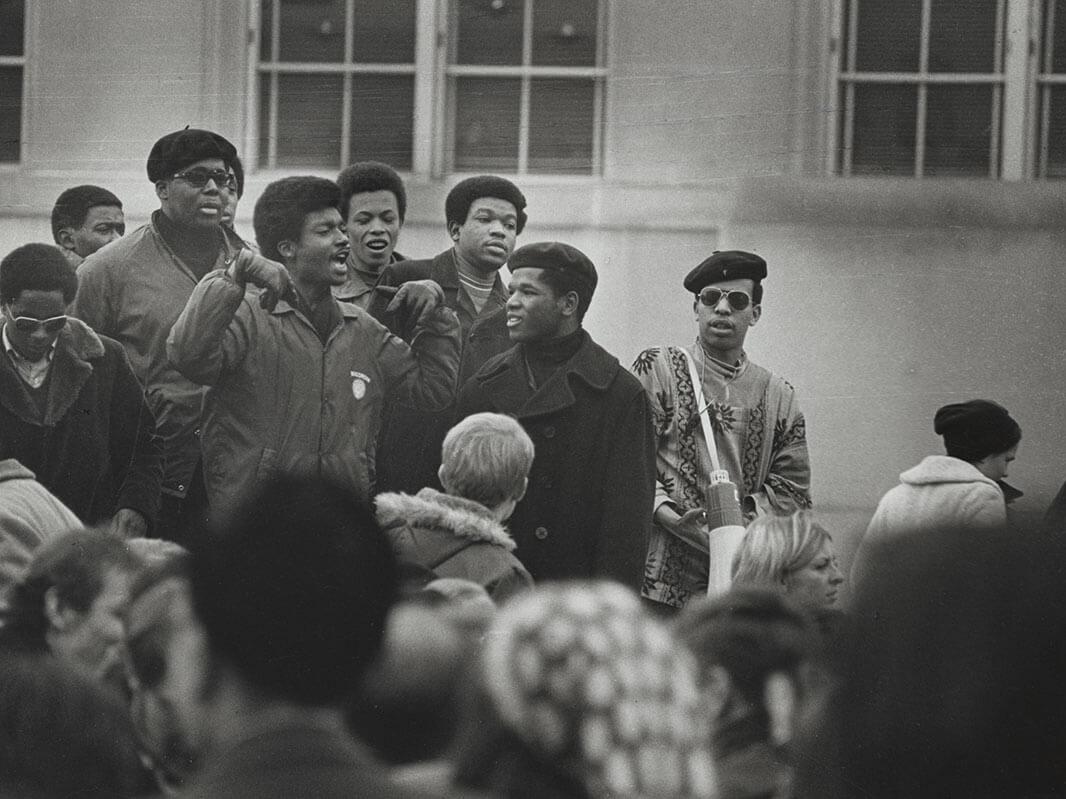
When Clay and other UW–Madison students learned about “Black Thursday,” they immediately took action. They demanded that Madison campus leaders deliver justice for both the Oshkosh protesters and for Black UW–Madison students. Clay remembered that a group of Black students under the name Black Peoples Alliance (BPA) “would meet and strategize and talk about, ‘How can we affect some change?’” The BPA discussed tactics, asking, “So we go tear something up? Do we fight? Do we arm?” Clay and the BPA, after years of working through the proper channels, felt the only power they had left was the power to disrupt. So, on February 7, 1969, they handed UW–Madison’s chancellor a list of 13 demands. “Autonomous Black Studies Department…” listed one demand. “Control of the Black Cultural Center be in the hands of Black students,” listed another. If the university did not meet the BPA’s demands, the BPA said they would strike. Unsurprisingly, but no less disheartening, UW–Madison leadership refused. And so, the strike began. 16
The strike, dubbed the Black Student Strike, was effective in two ways. First, the students’ disruption forced the university to respond. Second, it educated fellow students on why organizers were protesting in the first place. At the height of the strike, an estimated 10,000 students participated, mostly because of how effective Clay and the BPA’s educational tactics were. Some of their teaching occurred in classrooms when participants took over professors’ lectures. They “occupied” lecture halls, teaching students about their experiences at a PWI and why the university needed a Black Studies Department, a Black Cultural Center, and a more racially diverse campus. But education was not limited just to classrooms and lecture halls. It also occurred at marches and on picket lines. Despite the non-violent nature of demonstrations and education, the protest escalated when UW–Madison called the National Guard to end the strike. All of a sudden there were “National Guardsmen with drawn weapons and unsheathed bayonets in the streets.” 17
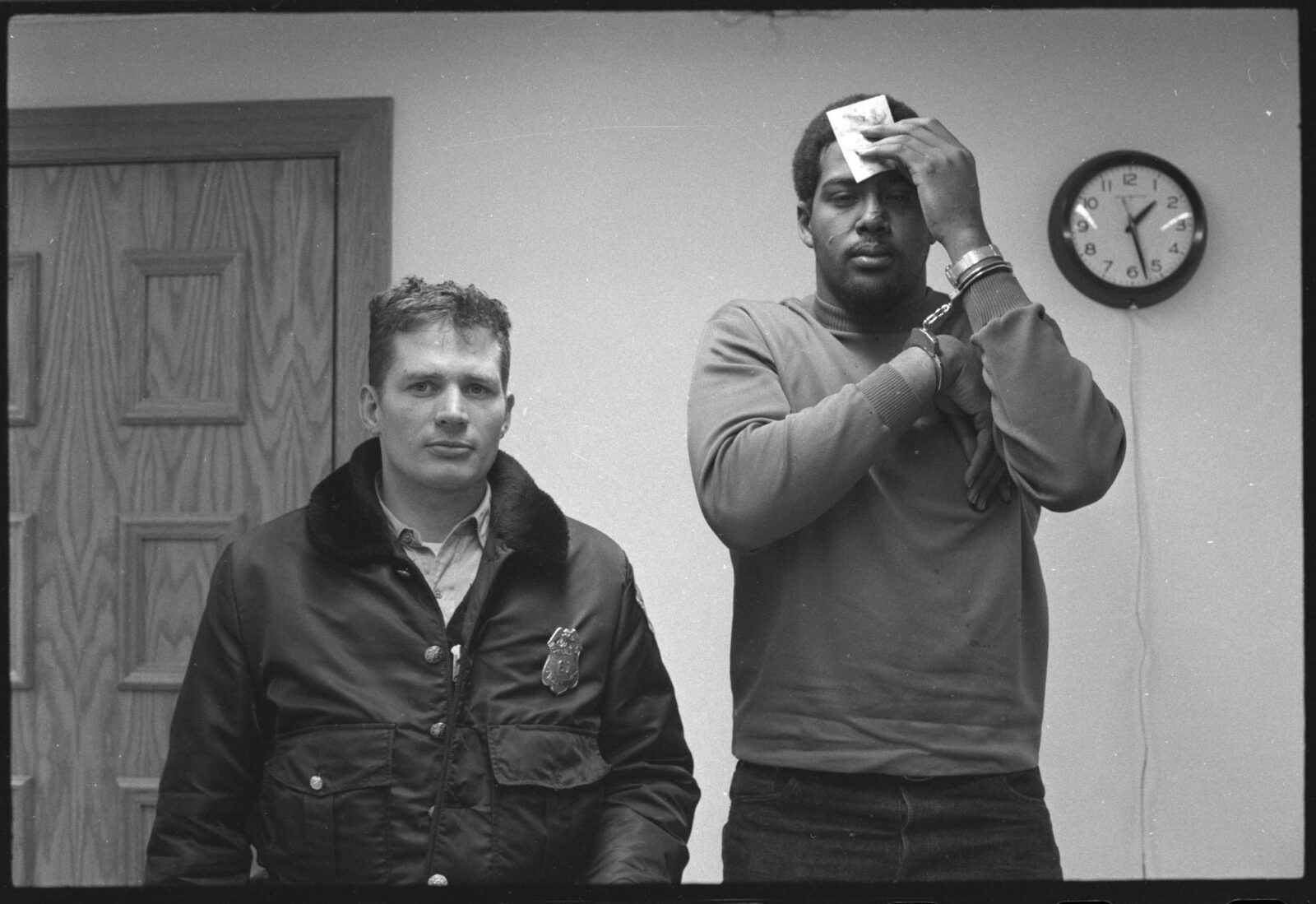
Harvey Clay stood at the front of one demonstration and was “just talking to people and trying to explain why we have this protest, and why we don’t think it’s fair, why the university needs to make some adjustments,” when the police targeted him. “I never threw a punch,” he remembered. “Next thing I know, I’m being beat on.” When Clay defended himself, the police cracked his head open and arrested him. The state violence became a turning point in the strike. Just as the pressure from the Black Greek-letter organizations got to be too much, the Black Student Strike forced the university to begin the discussion of accepting some demands. Out of the 13 demands, the university agreed to three, but only one still exists today: a Black studies department. 18
Regardless of the disappointing actions of the university, Stuart Levitan cites the Black Student Strike as “the single most successful protest of the era.” The strike deserves this title. Clay and the BPA, along with a coalition of white and brown students, altered the university’s cultural and intellectual landscape. For the following decades, the Black Student Strike provided a road map towards achieving greater equality on a college campus. Many more students would follow their path, including the members of La Raza Unida. 19
La Raza Unida, 1973-1977
Sylvia Garcia, David Saldaña, Emmet Campos, Tony Castañeda, and Daniel Malacara attended UW–Madison during the 1970s. Just like Jackson-Brunson and Clay, one of the first things they remembered was the overwhelmingly white campus environment. Garcia recalled that “coming to a university, where I was only five percent of the population of a Latino background, let me know that this institution was not very welcoming.” Similarly, Saldaña said that “there were just a handful of Chicanos” at UW–Madison and “even though there were thousands of students on campus, there were maybe 100-something Chicano Latino, maybe out of that, maybe 30 Chicano.” The whiteness of UW–Madison was most striking in their classrooms. Saldaña remembered “sitting in class, the first class I went to, I was like, ‘what the hell am I doing? There’s no other brown faces in the place.’” Campos similarly remembered, “The first day I was in class, I was just tripping. Why am I here? I’m in this classroom with 500 students, and I’m the only brown face I see.” Malacara and Campos both described being the only Chicano in a classroom as feeling invisible – until you’re not. “You’re in classrooms where you may be the only rep,” Campos said, “Then if anything comes up talking about Mexico or Chicano topics, they turn to you. You’re the spokesperson. So, there’s all kinds of ways that can be traumatic.” It was difficult, Garcia further explained, because “I wanted my education to be supportive of something that I thought was very important, and that was equal treatment, equal justice for a group that’s not given a lot of opportunity to shine.” Many, like Garcia, felt cheated by their education at a predominantly white institution, which would become their motivation to change the academic environment. For others, however, they experienced firsthand the potential of formal education as politicizing. 20
Saldaña, Campos, and Castañeda enrolled in Professor Prospero Saíz’s class on Chicano literature and were profoundly transformed. They remembered that it was the first time they had ever had any classes with other Chicano students. Campos remembered reading the works of Carlos Fuentes, Juan Rulfo, Tomas Rivera, Raul Salinas, and Saldaña remembered also reading Rodolfo “Corkey” Gonzales and Octavio Paz. “For a lot of us at that time, it helped politicize us,” said Castañeda. “It also gave us not only Chicano politics, but international politics.” Campos emphasized that it “is not cliché or hyperbole to say it was transformative to read literature and histories of your people.” They were learning theories about resistance and cultural pride, and the students of Professor Saíz were eager to put these theories into practice. For Saldaña, Campos, and Castañeda, La Raza Unida became their way to do just that. 21
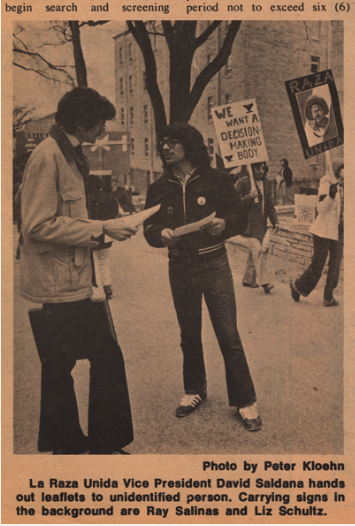
In the 1970s, Garcia, Saldaña, Campos, and Castañeda, among other UW students and local activists, organized La Raza Unida for Chicane/Latine students. Initially, the group did not have an official space for meetings on campus. Instead, they turned to the Cardinal Bar, the Union, and the 602 Club to meet. These spaces kept Garcia, Saldaña, Campos, Castañeda, and Malacara from dropping out. “If we didn’t have those spaces,” Campos said, “I would have left. Especially in January when that 30-degree-below weather hit. I think we lost half of our Tejanos after that first storm.” But it was also within those spaces that La Raza Unida expressed grievances and potential solutions. Garcia remembered that when she became an active member of La Raza Unida, “the main issue was self-identity and presence,” and La Raza Unida meetings often invigorated strategies for addressing such issues. Their primary strategy, Garcia said, “was that we really wanted to have a Chicano studies department at the University of Wisconsin–Madison.” 22
“We felt like a department would help not only in educating ourselves,” Garcia said, “but educating others what it meant to be a Chicana or Chicano.” A Chicano studies department would not only educate, but also help recruit and retain more Chicane/Latine students to stay in such an educational environment. Without a department and with an apathetic university, Castañeda remembered that “recruitment and retention were always big issues that we were talking about.” Even when the university recruited minority students, Castañeda said, “Yeah, they’re letting us in, but we got no support. We don’t know where to go.” So, La Raza Unida, like so many activists before them, tried to maneuver the proper channels to establish a department, but campus leadership did not listen. “Regardless of activity, we still felt like we weren’t being heard,” remembered Garcia, “so we started actually walking up and down [Bascom] hill and protesting… demanding that the university pay attention to us.” While some protested with marches and demonstrations, La Raza Unida also protested UW’s apathy by fulfilling the roles of recruitment and retention officers themselves. And they did so rather successfully. As Malacara put it, “This is a world-class university, right? When you’re here, and you’re in it, and you’re amazed by it, you’re inspired by it. You want to bring in more of your fellow Chicanos.” 23
A primary part of La Raza Unida’s political tactic was to diversify the student body. So, members drove around the country to recruit Chicane/Latine high school students. Saldaña pitched UW–Madison to these high school students by telling them, “You’re going to have a supportive group when you get here and join our group, and we’ll help you out… Because they too were going to be in our same situation when they got here.” Saldaña would even bring back high school students, after the parents signed a waiver, to visit the campus, meet Chicane/Latine students, and attend lectures. But perhaps the most educational experience for the visiting high schoolers was when La Raza Unida arranged them on the picket line. Saldaña wanted to show these prospective students that protesting and demanding change “is what we do here.” So, Saldaña told them, “Just grab a picket sign. Then they would march around. We wouldn’t keep them that long, maybe an hour or so.” According to Campos, one high school student on the picket line told them, “I think I like college.” 24
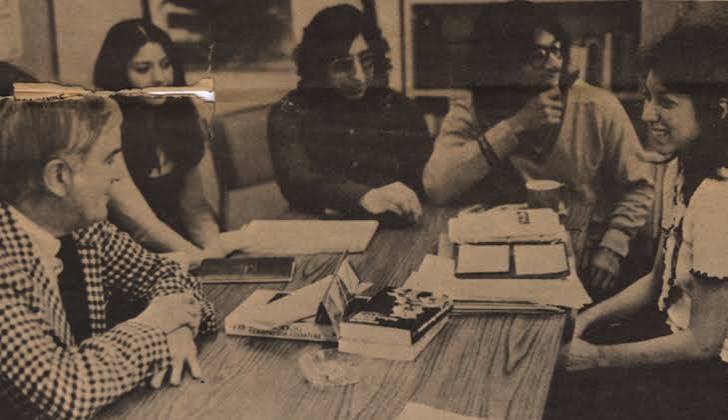
After mounting pressure from college students, and in this case, some high school students, the university established the Chicano Studies Program. But a program was not the same as a full department. It offered an area of study without full autonomy over faculty and curriculum. Much like with Clay and the BPA’s demands after the Black Student Strike, the university watered down La Raza’s demand for an autonomous department. But the protest for a Chicano studies department was successful in other ways. “Where I was probably most effective,” said Garcia, who became the president of La Raza Unida in 1975, “was raising awareness… activating and getting people aware and recognizing the need for the Chicano department.” Furthermore, the program did establish more classes like the one Dr. Prospero Saíz offered in the early 1970s. In fact, it was Saíz who offered the first Chicano studies course titled Comparative Literature 379: Literacy Group Experiences – The Chicano. The program continues to exist today, called the Chicanx/e and Latinx/e Studies Program, offering courses, a certificate, and B.A./B.S. degrees. The activism of La Raza Unida forever altered the university’s intellectual, cultural, and social environment, continuing the legacy of college student protests. But, as Garcia starkly reminds us, “the university has not done a thing” to ensure the success of La Raza Unida’s contributions. 25
Conclusion
The legacy of college protests, however, should go hand in hand with the university’s often disappointing responses. The campus environment creates fertile ground for student protests, but not necessarily because it provides support and guides emerging adults into becoming civically engaged citizens. The campus environment and leaders are so often the antagonist in many of these young activists’ stories. Even as this article comes out, hundreds of students at Cornell University are protesting against their administration’s gross mishandlings of sexual assault. 26 Stuart Levitan explains that tension between students and the university increases “because there’s a vicious cycle of protest, repression, more protest, more repression.” Simply put, “the empire always strikes back.” The university is not a utopia for protests. So perhaps the easier question to answer is why college students choose not to protest. 27
One reasonable explanation is the risks. There are physical, mental, and economic risks for college student activists, and not everyone encounters risk the same way. It was Harvey Clay, a Black football player, who the police targeted, beat, and arrested. In addition to his broken skull and arrest, UW–Madison revoked his football scholarship, essentially suspending him because without the scholarship, he could not afford the tuition. But the risks are not isolated to campuses. College student protests became a national security issue. Many Black students who participated in the Black Student Strike had their names and addresses published in Wisconsin newspapers, expanding their torment and surveillance statewide. Scholar Gregg L. Michel found that “the historical record is replete with examples of brutality and surveillance” towards student protest organizations, including the American Indian Movement, the Mexican American Youth Organization, the Puerto Rican Young Lords, the Black Panthers, and various women’s liberation movements. Michel’s book focuses particularly on the Civil Rights era, and found that “Black civil rights protesters and activists, and even those who merely sympathized with calls for racial equality, endured the abuse and harassment from law enforcement at all levels of government that extended over decades….white student activists simply did not suffer comparable abuse.” And according to some experts, the risks have only increased since the 1960s and 1970s. Levitan suggests that “today we live in such a surveillance state that things have gotten a lot worse in many ways.” Today, the “repercussions are greater,” Levitan argues, “I mean, Jesus, you could be deported. You could be arrested. You could disappear.” 28
And yet, college students continue to protest, even when facing an empire that always strikes back. The trouble is, students continue to protest because they continue to become frustrated with the injustices made apparent by the campus environment. They express their frustrations, along with their hopes, because they see college campuses’ potential in achieving greater equality. But whether by incoherent bureaucratic rules or violent means, campuses threaten the right of students to have a future they deserve. And when young people’s right to have a future is threatened, they will always react. So, instead of asking why college students protest, maybe we should be asking why the university continues to serve as a major obstacle to political expression and participation. There is hope, though. As Levitan puts it: “anything that chips away at the authority and power of the empire is good because if we win, victories have ripples.” With each college student protest comes, at the very least, a ripple of victories in forcing the university to reckon with itself. 29
- Philip G. Altbach and Patti Peterson, “Before Berkeley: Historical Perspectives on American Student Activism,” The ANNALS of the American Academy of Political and Social Science 395, no. 1 (1971): 1; Corydon Ireland, “Harvard’s Long-Ago Student Risings,” Harvard Gazette (April 19, 2012); Frank L. Ellsworth and Martha A. Burns, Student Activism in American Higher Education (Washington, DC: American College Personnel Association, 1970); University of Wisconsin–Madison, “Student Activism,” Sifting and Reckoning, https://reckoning.wisc.edu/student-activism/index.html; Stuart Levitan, interview by Kacie Lucchini Butcher and Allie Morris, June 8, 2026, interview conducted for season three of Reorientation, unpublished.
↩︎ - Jeffrey Jensen Arnett, “Emerging adulthood: A theory of development from the late teens through the twenties,” American psychologist 55, no. 5 (2000): 469-480.
↩︎ - According to David Saldaña, it is not the case that the second iteration of La Raza Unida, called Movimiento Estudiantil Chicano de Aztlán de UW–Madison (MEChA) was in existence in 1974-1975. He stated, “I learned this later that everyone was talking about Mecha being in existence since back in ’73-’74. That is not the case. We were La Raza Unida in 1973-’74, ’74-’75, ’75-’76. During my years here we were, La Raza Unida. We were not Mecha.” Similarly, Sylvia Garcia said, “I became very active in La Raza Unida, which was at that time the predecessor of MEChA. Today, the student organization continues to exist in its third iteration, under the name, Mecha De Teejop (UW–Madison). ↩︎
- University of Wisconsin–Madison, “Wisconsin Idea,” https://www.wisc.edu/wisconsin-idea/. ↩︎
- Sara Jackson-Brunson, interview by Kayla Rose Parker, University of Wisconsin Archives, Unaccessioned, Madison, WI, September 8, 2021. ↩︎
- Alpha Kappa Alpha Sorority, Incorporated, “Our History,” https://aka1908.com/about/our-history/ ↩︎
- Jackson-Brunson, interview; Alpha Kappa Alpha Sorority, Incorporated, “Our History,” https://aka1908.com/about/our-history/; Alpha Kappa Alpha Sorority, Incorporated, “Our Story,” https://aka1908.com/about/; Kayla Rose Parker, “Breaking Racial Lines: The Formation of Black Greek-Letter Organizations at UW–Madison,” Center for Campus History, October 29, 2021. https://campushistory.wisc.edu/breaking-racial-lines-the-formation-of-black-greek-letter-organizations-at-uw-madison/ ↩︎
- Jackson-Brunson, interview; Parker, “Breaking Racial Lines,” 2021. ↩︎
- Jackson-Brunson, interview; Parker, “Breaking Racial Lines,” 2021. ↩︎
- Jackson-Brunson, interview; Parker, “Breaking Racial Lines,” 2021. ↩︎
- Jackson-Brunson, interview; Parker, “Breaking Racial Lines,” 2021. ↩︎
- Jackson-Brunson, interview; Parker, “Breaking Racial Lines,” 2021. ↩︎
- Harvey Clay, “Interview with Harvey Clay,” interview by Ned Frame, UW–Madison Campus Voices, Public History Project, University of Wisconsin–Madison Libraries, Madison, WI, March 24, 2020. ↩︎
- Clay, interview. ↩︎
- University of Wisconsin–Madison, “Black Student Strike,” UW–Madison News, https://news.wisc.edu/black-student-strike/timeline/ ↩︎
- Clay, interview; University of Wisconsin–Madison, “Black Student Strike,” UW–Madison News, https://news.wisc.edu/black-student-strike ↩︎
- Clay, interview; University of Wisconsin–Madison, “Black Student Strike,” UW–Madison News, https://news.wisc.edu/black-student-strike; Levitan, Interview. ↩︎
- Clay, interview; University of Wisconsin–Madison, “Black Student Strike,” UW–Madison News, https://news.wisc.edu/black-student-strike ↩︎
- Levitan, interview. ↩︎
- Slyvia Garcia, Interview by Marcelo Heredia, Andrea-Teresa Arenas, Katherine Huete Galeano, and Linda Merchant, “Excerpts from Interview with Sylvia Garcia, October 14, 2012, Madison, Wisconsin,” Somos Latinas Project oral histories and collected papers, 1952-2015, Wisconsin Historical Society, Madison, WI, October 14, 2012; David Saldaña, Emmet Campos, Tony Castañeda, and Daniel Malacara, “CLS Alumni Organizer Interview,” interview by Taylor Bailey and Karla Martinez, University of Wisconsin- Madison Archives and Records Management, unaccessioned, July 17 2025. ↩︎
- Saldaña, et al., interview. ↩︎
- Garcia, interview. ↩︎
- Garcia, interview; Saldaña, et al., interview. ↩︎
- Saldaña, et al., Interview; University of Wisconsin–Madison, Chicanx/e & Latinx/e Studies, “History,” https://chicla.wisc.edu/history/ ↩︎
- Garcia, interview; University of Wisconsin–Madison, Chicanx/e & Latinx/e Studies, “History,”
https://chicla.wisc.edu/history/ ↩︎ - Aurora Berry, “Cornell students call for change amid reopened investigation into alleged assault,” NPR (October 8, 2026), https://www.npr.org/2026/10/08/nx-s1-5991800/cornell-students-call-for-change-amid-reopened-investigation-into-alleged-assault ↩︎
- Levitan, interview. ↩︎
- Clay, interview; Gregg L. Michel, Spying on Students: the FBI, Red Squads, and Student Activists in the 1960s South (LSU Press, 2024), 4-5; Levitan, interview. ↩︎
- Levitan, interview. ↩︎